
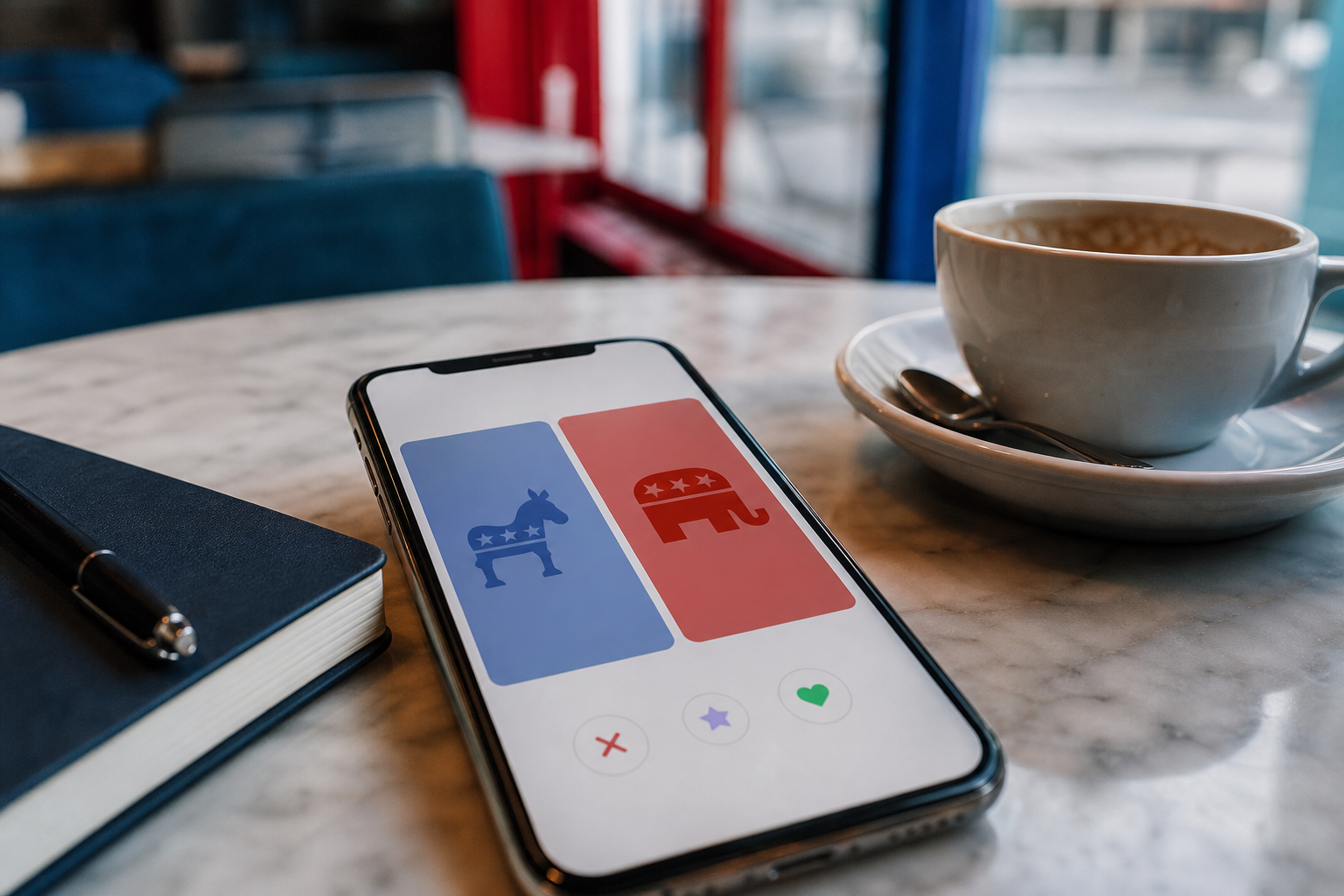
Symbolbild mithilfe von KI erstellt
Study on Online Partner Search
Why Politics Is Increasingly Becoming a Dealbreaker in Dating
A single line in a profile—“Democrat,” “Republican,” or nothing at all—can trigger much more than a harmless self-description in online dating. A study from Cologne shows that young adults in the US use political cues as a strong selection criterion. And: Those who are perceived as politically “different” not only get fewer chances for a first meeting, but are also devalued in key personality traits.
Political Information Acts as a Quick Filter
The study comes from Ansgar Hudde and Shannon Taflinger (University of Cologne) and was published in the journal European Sociological Review. In an online experiment, 1,097 Americans aged 20 to 33 evaluated fictional dating profiles. These were designed just like users know them from common apps—with the crucial difference that the profiles were labeled either as “Democrat,” “Republican,” or without any political information.
The result: Political affiliation clearly influenced the willingness to meet. Many respondents from both major camps filtered out profiles from the other side. There were differences: Participants with a Democratic preference were almost as open to profiles without political information as to other Democrats. Among participants with a Republican preference, there was a clearer preference for political like-mindedness.
There was also a noticeable gender effect: The data showed that Democratic women based their selection particularly strongly on political signals. Their rejection of the other political side was about four times as strong as that of Republican women or men.
Why Politics Is Read as a Personality Test
Crucially, the political label in the profiles did not act in isolation. In the evaluations, “Democrat” or “Republican” was apparently read as shorthand for a whole package of expectations: values, lifestyle, moral attitudes, but also assumed character traits.
The study reports that those with different political views were consistently rated more negatively—across all queried dimensions. These included assessments of intelligence as well as character traits like honesty and friendliness, and the presumed similarity in values and lifestyle.
This helps explain why a political line in the profile has such a strong effect: For many, it serves as a signal of whether a relationship could be low-conflict, compatible, and socially acceptable in everyday life—or whether fundamental friction is expected before a conversation even begins.
The mechanism is not just “preference for similarity.” The analysis also looked at which intermediate steps play a role: for example, the question of which traits are attributed to the other side, how likely shared life plans are considered, and whether social approval from one’s own circle is expected. This exact combination makes political sorting in dating so powerful: It’s not just about opinion, but about the expectation of who someone is “as a person.”
Apps Increase Visibility—and Thus the Preselection
Online dating platforms are built for quick decisions: a picture, a few lines, a swipe.
Political information fits this logic because it serves as orientation within seconds. In addition: Such information is not simply “neutral.” Platforms sometimes treat political views as particularly sensitive data; users decide whether to provide, display, or remove them. Precisely because the information is optional, it is interpreted even more strongly if present: Those who show it send a signal—and those who leave it out can also be read as “unclear” or “evasive.”
This creates a preselection that takes effect long before the first date. This can reduce conflicts—but also means that encounters across political lines become rarer, even if the actual differences in everyday life might be smaller than assumed.
What Can and Cannot Be Transferred to Germany
The US findings can only be transferred to Germany to a limited extent. The US is strongly structured into two camps due to its de facto two-party system; political identity is often understood as belonging—with correspondingly sharp boundaries. In Germany, political orientation is spread across several parties and coalition options, which allows for more gradations and overlaps.
At the same time, parallels are plausible: There are likely situations here as well where people sort out potential partners early for political reasons—not necessarily because of individual issues, but out of fear of incompatibility in core values and lifestyle. Hudde also points to the growing political gender gap: As young women and men increasingly diverge politically, this can further complicate the search for a partner—because the pool of seemingly “suitable” people in one’s own age group subjectively shrinks.
One important point remains: Political “bubbles” are not automatically the majority, even if they seem particularly visible on social media and in the dating context. But this very visibility can reinforce the impression that the fronts are consistently hardened—and thus lower the willingness to allow an encounter at all.
Politics as a Private Matter? Less and Less in Dating
The Cologne study shows above all one thing: Political orientation is no longer a minor detail in digital dating. It is read as a signal for values, lifestyle, and character—and can decide in seconds whether someone gets a chance or not. Thus, political polarization is moving into an area long considered apolitical: private partner choice. And it is precisely there that it can have a particularly lasting social impact—quietly but consistently, match by match.
Frequently Asked Questions
Sources
- https://www.radiobielefeld.de/nachrichten/nrw-und-die-welt/koeln-studie-politik-beeinflusst-partnersuche.html, 02.06.2026
- https://doi.org/10.1093/esr/jcag020
- https://www.bpb.de/themen/nordamerika/usa/313005/politische-polarisierung-in-den-usa-zum-verhaeltnis-der-demokraten-und-republikaner/
- https://support.bumble.com/hc/en-us/articles/28530907109405-How-Bumble-uses-the-information-on-your-profile