
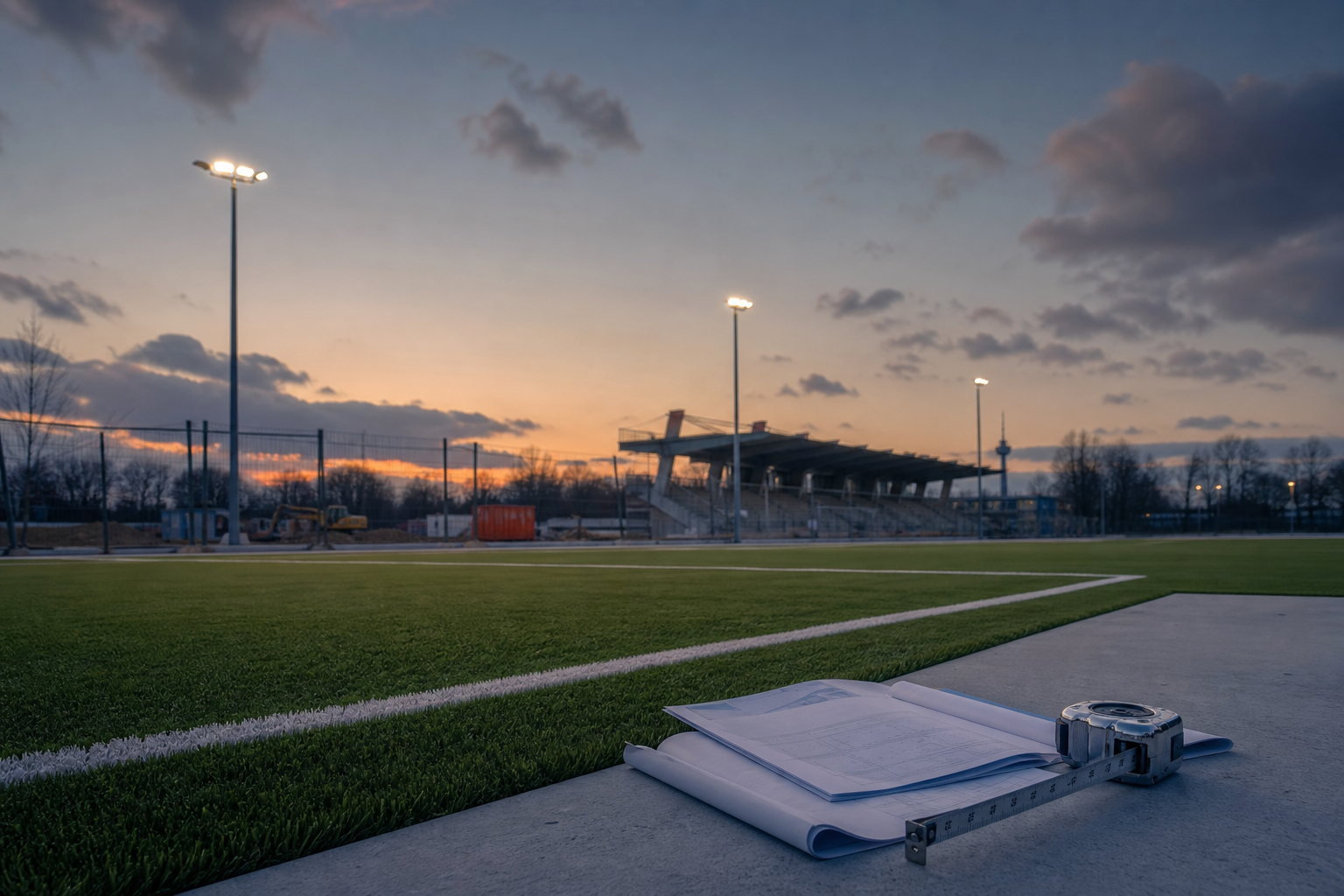
Symbolbild mithilfe von KI erstellt
Cologne Sports Facilities Facing Important Decisions
Cologne's Sports Traffic Jam to End: FC, Fortuna, and Viktoria Face Decisive Turning Points
Movement is coming to several long-blocked sports facility projects in Cologne. At 1. FC Köln, Fortuna Köln, and Viktoria Köln, decisions are coming together in the coming weeks and months that will directly affect training, infrastructure, and match operations—and at the same time show how closely progress in the city is tied to permits, majorities, and financing issues.
FC: Verdict, Construction Plan—and Immediately the Battle for Alternative Spaces
Oliver Seeck (SPD), chairman of the Sports Committee of the City of Cologne and chairman of the supervisory board of Kölner Sportstätten (KSS), emphasizes the significance of the date on June 11: “It’s about whether FC is allowed to build three football pitches on the Gleueler Wiesen.”
Regardless of the outcome of the proceedings, a practical bottleneck is already coming into focus: With the construction of the performance center, the artificial turf pitch next to the Franz-Kremer-Stadion would be eliminated. This immediately creates additional pressure to secure training capacities—not only for the professional sector, but also for youth and follow-up uses.
Seeck announces that the city wants to act quickly after June 11: “We want to provide clarity directly after June 11 and then make at least two satellite pitches available.” He names the following options:
- a pitch at Fort VI at Decksteiner Weiher, which is to be converted into an artificial turf field
- a nearby competition ground with natural grass, which could be converted into an artificial turf field and additionally equipped with floodlights
This is exactly where the fundamental political problem becomes visible, which slows down many projects in Cologne: The need is recognized, the areas are identified—but the majorities are not secured. Seeck says openly: “But there is no majority for this in the council.” According to political sources, objections from the Greens play a role in the debate, for example because of additional sealing of green spaces and the planned floodlights. For FC, this means: Even if a construction project is fundamentally decided, the availability of alternative pitches also determines whether the schedule remains realistic.
Fortuna Köln: More Training Pitches—and a Südstadion That Must Meet 3rd League Standards
The pressure to act is also high at Fortuna Köln. Seeck summarizes the situation of the two Cologne third-division teams as follows: “Both stadiums have a renovation backlog.”
For Fortuna, it is initially about training areas in the Jean-Löring-Sportpark. “Fortuna needs more training pitches,” says Seeck. The bottlenecks extend to the youth: “Sometimes the children have to train far away in Bocklemünd.” At Sporthof Süd, a solution is emerging according to him—“close to an agreement.”
At the same time, concrete modernization steps are pending at the Südstadion:
- Roofing of the stand on the opposite side (building permit has been granted)
- Modernization of the floodlight system according to TV requirements for the 3rd league
According to him, KSS and the club are currently looking for a compromise on financing. The core conflict is typical for municipal stadiums: Structural requirements from match operations meet limited budgets and the question of who should pay for which standards.
Viktoria Köln: Need for Renovation Within the Tight Constraints of Nature Conservation
The situation at Sportpark Höhenberg is different—but no less complicated. Seeck emphasizes the framework conditions: Because the sports park is located in a nature reserve, larger structural changes are “very difficult to implement.” This inevitably shifts the focus from major reconstruction plans to what is even feasible under legal and environmental conditions.
Nevertheless, the need for renovation remains acute. “Here too, the uncovered stand is a big issue, which is currently being discussed with the KSS,” says Seeck. For Viktoria, this means: Improvements are possible, but will probably have to be considered in smaller, approvable steps—with correspondingly longer coordination and decision-making processes.
A Pattern Runs Through All Three Cases
Overall, a consistent picture emerges: Projects are moving in Cologne, but the decisive hurdles lie in the details—at court dates, council majorities, environmental requirements, land use conflicts, and financing models.
With the approved performance center, 1. FC Köln has taken a central step, but at the same time, the impending loss of a pitch increases the pressure to quickly create reliable alternative spaces.
Fortuna needs additional training opportunities and must further develop the Südstadion to meet third-division standards.
Viktoria is slowed down by its location in a nature reserve and must negotiate renovation and modernization within tight limits.
Cologne is working on several construction sites at once. Decisions, permits, and discussions are ongoing—but the sports facility backlog has not yet been resolved.
Frequently Asked Questions
Sources
- https://www.express.de/sport/fussball/1-fc-koeln/stadien-plaetze-fc-fortuna-viktoria-es-passiert-jetzt-einiges-in-koeln-1295448, 08.06.2026
- https://www.stadt-koeln.de/politik-und-verwaltung/presse/mitteilungen/27073/index.html
- https://www.fortuna-koeln.de/aktuelles/news/meldung/die-baugenehmigung-fuer-das-dach-auf-stehplatz-mitte-ist-erteilt/