
Jean-Philippe Rameau
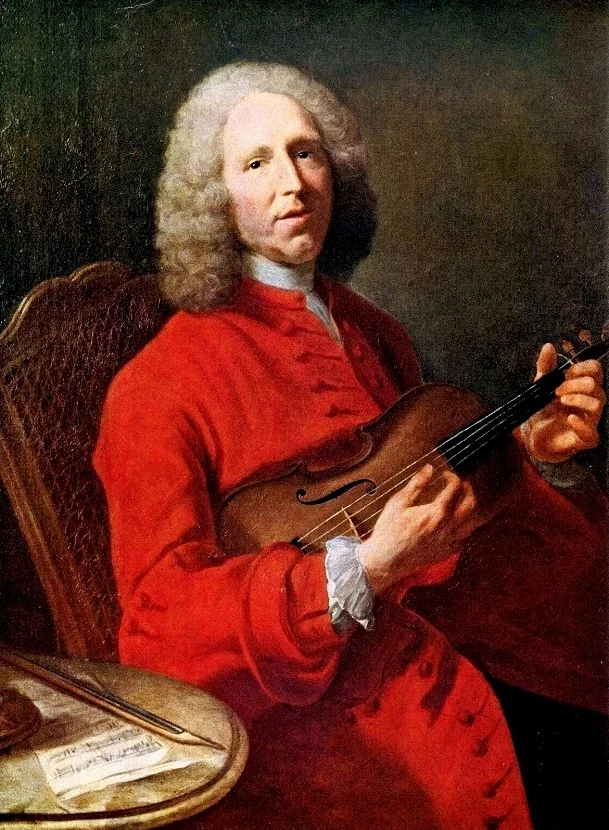
Image from Wikipedia
Image from Wikipedia
Jean-Philippe Rameau – the Great Sound Architect of French Baroque
A composer who rethought harmony and radically renewed opera
Jean-Philippe Rameau is one of the most influential figures in French music history: a composer, harpsichord virtuoso, organist, and music theorist all in one. He was born in 1683 in Dijon and passed away in 1764 in Paris. His path led from church organist to the radical renovator of opera, whose works and writings fundamentally changed European musical culture. ([de.wikipedia.org](https://de.wikipedia.org/wiki/Jean-Philippe_Rameau?utm_source=openai))
Rameau did not start as a celebrated opera star, but rather as a practical musician of everyday life: for many years he worked primarily as an organist in various French churches, frequently interrupting his appointments. It was only with his move to Paris in 1722, in the context of his theoretical work on harmony, that his career gained a decisive artistic focus. There he developed the profile of a musical thinker who combined practice and theory in extraordinary ways. ([de.wikipedia.org](https://de.wikipedia.org/wiki/Jean-Philippe_Rameau?utm_source=openai))
Biography: From Dijon to Paris – the Long Road to His Own Style
Rameau came from a musical family; his father was an organist, and his early exposure to keyboard instruments and church music shaped his artistic language. A study trip took him as far as Milan, but his true terrain remained France, where he held organ positions in Clermont-Ferrand, Paris, Dijon, Lyon, and back in Clermont. These stops shaped a musician who connected the liturgical seriousness of the organ with the elegance of the French style. ([de.wikipedia.org](https://de.wikipedia.org/wiki/Jean-Philippe_Rameau?utm_source=openai))
The decision for Paris was more than a change of location: it marked the transition from regionality to the intellectual and aesthetic debate of the capital. In the circles of Alexandre Le Riche de La Pouplinière, Rameau found long-term protection, space, and opportunities for influence; shortly before his death, he was even elevated to the nobility. This shows how highly regarded he was at the end of his life, even though his major opera successes were not initially self-evident. ([de.wikipedia.org](https://de.wikipedia.org/wiki/Jean-Philippe_Rameau?utm_source=openai))
Career: The Breakthrough Came with Theory – and with Opera
Rameau's first major theoretical work, the Traité de l’harmonie of 1722, made him a central thinker in the art of music. In these writings, he traced musical practice back to a natural principle and developed the idea of basse fondamentale, which he used to explain chord structure and harmonic movement anew. This was a watershed moment for music theory in the 18th century. ([de.wikipedia.org](https://de.wikipedia.org/wiki/Jean-Philippe_Rameau?utm_source=openai))
As an opera composer, Rameau only came to the forefront at the age of 50, but it was precisely here that his true historical greatness unfolded. His Tragédie en musique connected to Jean-Baptiste Lully, but went far beyond him in orchestration, contrast design, and harmonic expressiveness. Particularly in Hippolyte et Aricie and later in Castor et Pollux, his ability to generate dramatic tension from sound architecture was displayed. ([fr.wikipedia.org](https://fr.wikipedia.org/wiki/Jean-Philippe_Rameau?utm_source=openai))
Musical Signature: Elegance, Power, and Harmonic Boldness
In his harpsichord works, Rameau took inspiration from François Couperin, but he expanded upon Couperin's fine textures with greater contrapuntal depth and harmonic boldness. These pieces connect virtuosity with character portrayal; they are not merely courtly miniatures but sounding spaces with precise affect and clear gesture. Especially in his keyboard music, Rameau's ability to enliven musical forms with particular colorfulness is evident. ([de.wikipedia.org](https://de.wikipedia.org/wiki/Jean-Philippe_Rameau?utm_source=openai))
His operas give the orchestra a new dramatic significance. In Rameau's works, instrumentation is not just used to accompany, but as a driving force of the scene that creates conflict, movement, and atmosphere. At the same time, his melodies consistently follow the harmony: the expression of the music arises from the inner logic of sound, not from external decoration. ([de.wikipedia.org](https://de.wikipedia.org/wiki/Jean-Philippe_Rameau?utm_source=openai))
Discography and Reception: From Controversy to Recognition
Rameau's output includes operas, ballet operas, harpsichord cycles, chamber music, and theoretical treatises. Key works include Hippolyte et Aricie (1733), Les Indes galantes (1735), Castor et Pollux (1737), Dardanus (1739), and Les fêtes d’Hébé (1739). His Pièces de clavecin en concerts from 1741 and his later theoretical texts also mark important points in his artistic development. ([fr.wikipedia.org](https://fr.wikipedia.org/wiki/Jean-Philippe_Rameau?utm_source=openai))
Contemporary reception was fiercely contested. Initially, conservative "Lullists" and "Ramists" opposed each other, later resulting in the Buffonist controversy, where Jean-Jacques Rousseau positioned Italian music against Rameau's style. These conflicts show how modern and provocative his art was at the time: Rameau was not merely a preserver of tradition but a revolutionary within courtly aesthetics. ([de.wikipedia.org](https://de.wikipedia.org/wiki/Jean-Philippe_Rameau?utm_source=openai))
Later, his stage presence dwindled in the late 18th century before slowly being rehabilitated in the 19th century. Today, his oeuvre is firmly established in historically informed performance practice, and new recordings, concert series, and opera productions keep his music alive. The discography surrounding Rameau is now immense and goes far beyond individual standard works. ([de.wikipedia.org](https://de.wikipedia.org/wiki/Jean-Philippe_Rameau?utm_source=openai))
Current Attention: Rameau Remains Present on Stage
Even in 2024 and 2025, Rameau will remain present in concert and opera operations, especially through programs of the early music scene and through repertoire cultivation at major institutions. Philharmonic and orchestra listings show that works like Les Indes galantes or Hippolyte et Aricie continue to be performed and integrated into new concert formats. This underscores that Rameau is not just a figure of music history, but a living repertoire. ([oe1.orf.at](https://oe1.orf.at/programm/20260423/829388/Alte-Musik-von-Rameau-bis-Marais?utm_source=openai))
His presence in today's programs points to a rare dual role: Rameau is both a historical classic and a case study for interpretive nuances. Conductors, ensembles, and harpsichordists turn to him because his scores combine structure, dance, color, and dramatic energy in ideal balance. For this reason, he remains attractive to specialists and rediscoverers alike. ([oe1.orf.at](https://oe1.orf.at/programm/20260423/829388/Alte-Musik-von-Rameau-bis-Marais?utm_source=openai))
Cultural Influence: Music Theory as a Driving Force for Composition
Rameau's theoretical thinking was far more than academic sideline activity. His music theory placed harmony at the center of musical understanding and influenced generations of composers and thinkers. In this sense, he operated in dual capacity: as a creator of sounding works and as an author of a theory that systematized musical practice while simultaneously provoking it. ([de.wikipedia.org](https://de.wikipedia.org/wiki/Jean-Philippe_Rameau?utm_source=openai))
His significance extends beyond France into the history of European opera and ideas. Rameau helped redefine French opera after Lully, and his works were later regarded as a means to reform the Italian opera seria. It is precisely in this ambivalence that his stature lies: he is both a traditionalist and a modernizer, a scholar and a stage artist, a systematizer and a fantasist. ([de.wikipedia.org](https://de.wikipedia.org/wiki/Jean-Philippe_Rameau?utm_source=openai))
Conclusion: Why Jean-Philippe Rameau Continues to Fascinate Today
Jean-Philippe Rameau remains captivating because he reshaped French Baroque music with extraordinary intelligence, dramatic power, and harmonic invention. His career illustrates how an organist could become a composer of international scope and a theorist of lasting importance. Those who listen to his operas and harpsichord works do not experience museum music, but rather an art full of tension, brilliance, and intellectual precision. ([de.wikipedia.org](https://de.wikipedia.org/wiki/Jean-Philippe_Rameau?utm_source=openai))
Rameau is worth rediscovering on stage and in the concert hall because his music still surprises with colors, contrasts, and architectural clarity. His works are among the great highlights of the Baroque, and especially in live performance do they unleash their full power. Anyone who appreciates musical sophistication, dance energy, and intellectual depth should definitely experience Rameau. ([oe1.orf.at](https://oe1.orf.at/programm/20260423/829388/Alte-Musik-von-Rameau-bis-Marais?utm_source=openai))
Official Channels of Jean-Philippe Rameau:
- Instagram: No official profile found
- Facebook: No official profile found
- YouTube: No official profile found
- Spotify: https://open.spotify.com/artist/4JSWO1Pf2zV991fq64uAce
- TikTok: No official profile found