
Dea Loher
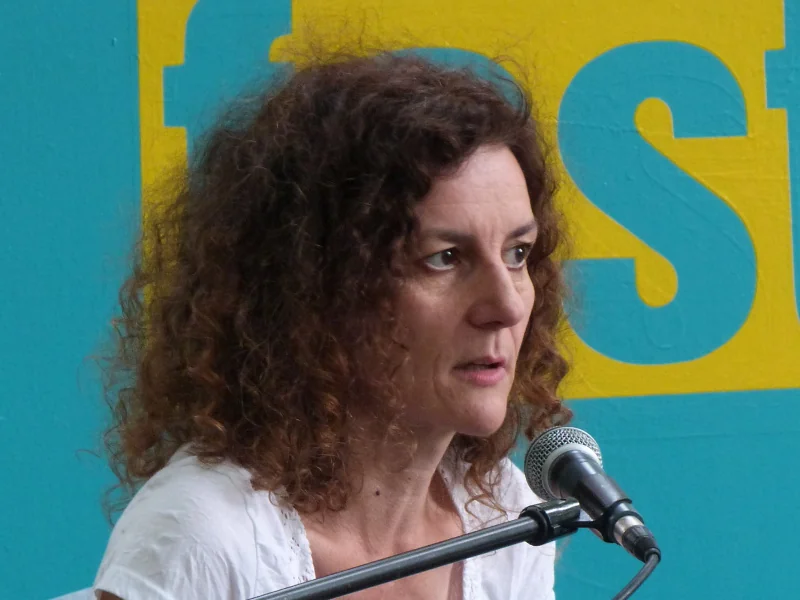
Image from Wikipedia
Image from Wikipedia
Dea Loher: The Playwright of Subtle Tremors
An author who shapes contemporary theater with clarity, rhythm, and emotional power
Dea Loher is one of the defining voices of contemporary German-language theater. Born in 1964 in Traunstein, the playwright and prose author has created a body of work that reveals social realities, marginalized figures, and fragile relationships with rare precision. Her biography is closely linked to a literary attitude that shuns the spotlight and instead emphasizes concentration, formal awareness, and observation. ([goethe.de](https://www.goethe.de/ins/ro/de/kul/sup/nss/22344745.html))
From Traunstein to Munich and Berlin: Artistic Origins
Dea Loher was born as Andrea Beate Loher in Traunstein in Upper Bavaria and claims to have grown up as an only child in an isolated environment. The familial influences, the rural setting, and the experience of seclusion are reflected later in many of her plays, where outsiders, seekers, and vulnerable individuals take center stage. After graduating from high school, she studied German studies and philosophy in Munich and continued her training at the Berlin University of the Arts in the field of dramatic writing, among others with Heiner Müller. ([uni-due.de](https://www.uni-due.de/literarikon/loher.php))
This early academic and artistic formation is, metaphorically speaking, just as important for her music career as it is for a composer: Loher thinks in arcs of tension, repetitions, and precise shifts. Her texts operate with their own rhythm, with laconic compression and a dramaturgy that does not explain the characters but puts them in motion. It is precisely this quality that creates the intensity that critics often describe as "loheresk." ([verlagderautoren.de](https://www.verlagderautoren.de/buch-verlag/autorinnen/portrait/autor/dea-loher.html))
The Breakthrough in Theater: Early Plays and the Path to Mastery
Her first play, Olgas Raum, premiered in 1992; this was followed by Tätowierung and Leviathan in the same year, as well as Fremdes Haus, Blaubart, and finally Adam Geist. Loher quickly became one of the most performed and productive young theater authors of her generation. The breakthrough did not come as a single moment but as a result of an astonishingly consistent body of work, in which style, themes, and societal observations became increasingly condensed. ([goethe.de](https://www.goethe.de/ins/ro/de/kul/sup/nss/22344745.html))
A particularly important collaboration was with director Andreas Kriegenburg, who premiered many of her plays starting with Fremdes Haus. This artistic partnership significantly shaped the reception of her work, as it translated Loher's texts into precise, often visually striking stage spaces. In this way, a theater cosmos emerged, where language, space, and character constellation are intricately intertwined. ([verlagderautoren.de](https://www.verlagderautoren.de/buch-verlag/autorinnen/portrait/autor/dea-loher.html?utm_source=openai))
Biographical Condensation and Societal Perspective
Loher has never viewed herself as an author of grand public appearances. Research describes her as reserved, sparing with interviews, and cautious towards cultural operations. This distance enhances the authority of her work, as it is not based on cult of personality but on literary substance, formal precision, and thematic consistency. ([uni-due.de](https://www.uni-due.de/literarikon/loher.php))
Substantively, her dramas revolve around the dark and fragile sides of modern societies: unemployment, violence, migration, familial closeness, loneliness, hope, and overwhelm. The characters often come from the margins of the social fabric, but Loher treats them not documentarily but with poetic compression. Her texts create intimacy without smoothing over the harshness of circumstances. ([goethe.de](https://www.goethe.de/ins/ro/de/kul/sup/nss/22344745.html))
Works, Discography, Opera Librettos, and Prose: A Multifaceted Oeuvre
Although Dea Loher is not a musician, her work exhibits a remarkable proximity to musical dramaturgy. Her texts are structured in scenes that repeat and vary like motifs; dialogues and tableaus create a sort of literary arrangement. Her body of work includes not only plays but also prose and opera librettos, including Licht with music by Wolfgang Böhmer as well as Weine nicht, singe and Diodati. Unendlich with music by Michael Wertmüller. ([de.wikipedia.org](https://de.wikipedia.org/wiki/Dea_Loher))
In prose, the short story collection Hundskopf was published in 2005, and the novel Bugatti taucht auf followed in 2012. In theater, plays such as Quixote in der Stadt, Land ohne Worte, Das letzte Feuer, Diebe, Am Schwarzen See, Gaunerstück, Bär im Universum, and Frau Yamamoto ist noch da mark central points of a long artistic development. This sequence of works shows an author who continually expands the genre while consistently maintaining her signature. ([de.wikipedia.org](https://de.wikipedia.org/wiki/Dea_Loher))
Stylistics and Language: Laconic, Condensed, Emotionally Intense
The literary scholarly literature describes Loher's language as cool, laconic, and highly condensed. This is where her particular strength lies: she avoids over-explanation and instead relies on reduced dialogues, precise character guidance, and a stage poetics that makes undertones audible. Her texts connect social analysis with emotional intensity, thereby creating a theater of clear edges. ([uni-due.de](https://www.uni-due.de/literarikon/loher.php))
Some reviewers emphasize that her plays do not lend themselves to simple labeling. The Verlag der Autoren describes the works as exceptionally intelligent, linguistically powerful, and emotionally intense; in 2008, Theater heute awarded Das letzte Feuer the title of Play of the Year. Such reactions underline the authority of a dramatic art that has long held intrinsic value in German theater. ([verlagderautoren.de](https://www.verlagderautoren.de/fileeditor/user_upload/Buchvorschau/Buchvorschau_2024_Herbst_web.pdf))
Cultural Influence and Awards: A Mainstay of Contemporary Theater
Since the 1990s, Dea Loher has been one of the most discussed German-language theater authors. Her plays have been translated into more than 15 languages and performed worldwide, showcasing her international standing. With Diebe, in 2010, one of her plays was presented for the first time at the Berliner Theatertreffen, further evidence of the lasting relevance of her work. ([verlagderautoren.de](https://www.verlagderautoren.de/buch-verlag/autorinnen/portrait/autor/dea-loher.html?utm_source=openai))
Among her most significant awards are the Mülheimer Dramatikerpreis for Adam Geist and later for Das letzte Feuer, the Berlin Literature Prize, the Bertolt Brecht Literature Prize, the Joseph Breitbach Prize, and the Samuel Bogumil Linde Prize. Since 2013, she has been a member of the German Academy for Language and Literature, and since 2016 of the Academy of Arts. This institutional embedding shows how significantly her work is regarded as culturally important. ([goethe.de](https://www.goethe.de/ins/ro/de/kul/sup/nss/22344745.html))
Recent Projects and Recent Reception
In 2024, Dea Loher made a remarkable return with Frau Yamamoto ist noch da. The play premiered in September 2024 simultaneously at the Schauspielhaus Zürich and in Tokyo and was highlighted by official announcements as a new, long-awaited theater piece. The production depicts a society seeking closeness while simultaneously suffering from its own lack of connection; in this way, Loher continues her precise observation of the present. ([verlagderautoren.de](https://www.verlagderautoren.de/fileeditor/user_upload/Buchvorschau/Buchvorschau_2024_Herbst_web.pdf))
Also in 2025, the play remained prominent: it was nominated for the Mülheimer Dramatikpreis, and the jury of Theater heute awarded Frau Yamamoto ist noch da the title of Play of the Year 2025. This shows that Loher's writing is not only historically significant but also shapes current discussions and creates new moments on stage. ([open.spotify.com](https://open.spotify.com/episode/0Q4AI7mj3QKZcXuMMcQDZL?utm_source=openai))
Conclusion: Why Dea Loher Remains
Dea Loher is compelling because she uses theater as a resonance space for societal upheavals, quiet injuries, and human longing. Her works combine formal rigor with empathy, poetic compression with political acuity, making her one of the most important authors of her time. Anyone who wants to experience contemporary theater at the highest level should see Dea Loher on stage, where her language, her characters, and her precise dramaturgy come into their full effect. ([goethe.de](https://www.goethe.de/ins/ro/de/kul/sup/nss/22344745.html))
Official Channels of Dea Loher:
- Instagram: no official profile found
- Facebook: no official profile found
- YouTube: no official profile found
- Spotify: no official profile found
- TikTok: no official profile found
Sources:
Upcoming Events
Ms. Yamamoto is still here