Urban Transformation in Cologne: New Neighborhoods and Projects
Urban Transformation: New Neighborhoods & Projects in Cologne (Outlook)
In Cologne, several major urban development projects are planned for the coming years, aiming to transform former port, industrial, and transport areas into mixed-use neighborhoods, green spaces, and new centers. This overview summarizes the most important initiatives, classifies goals such as climate resilience, affordable housing, and short distances – and shows what is likely to change for everyday life, mobility, and the local economy.
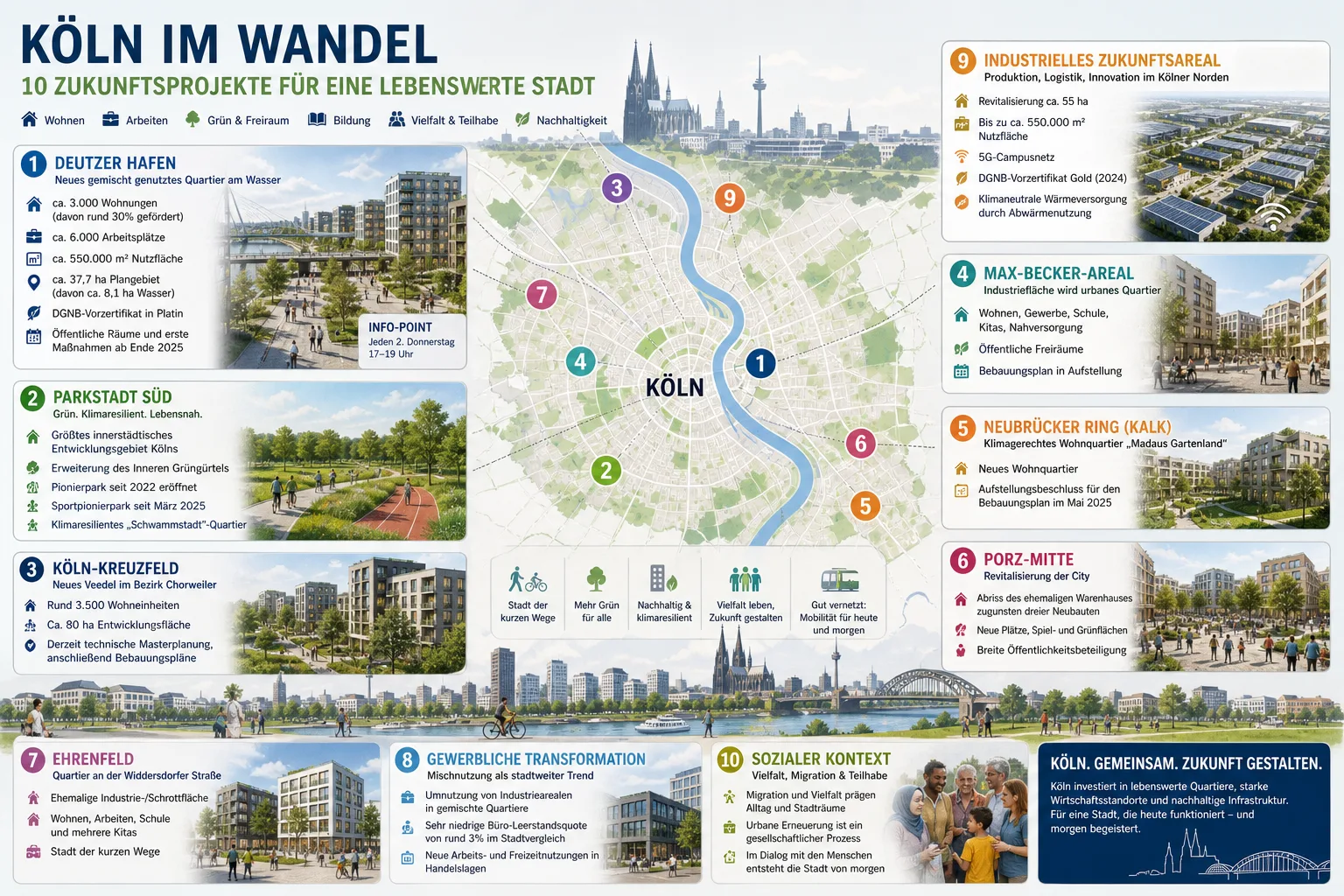
Deutzer Hafen: Mixed-Use Waterfront District with Platinum Ambition
At Deutzer Hafen, a new mixed-use district on the water is planned. The plans include areas for living, working, gastronomy, culture, and publicly accessible waterfront spaces. The goal is a neighborhood that can be used both during the day and in the evening and strengthens the connection between the Rhine, Deutz, and the city center.
According to the City of Cologne, the development area covers around 37.7 hectares (of which about 8.1 hectares are water areas) with a total of around 550,000 m² of planned usable space. About 3,000 apartments (including a share of subsidized housing) and areas for around 6,000 jobs are planned.
For sustainability quality, certification in the DGNB system is planned or specified in planning documents (including high requirements for energy, resources, mobility, and neighborhood quality). Public paths, squares, and waterfront areas are to be implemented gradually from the end of 2025. On-site information and digital project pages are intended to transparently accompany the construction phases and participation opportunities.
- For residents: additional apartments, new local supply and leisure options, and easily accessible paths by the water.
- For visitors: new promenades, gastronomy and cultural venues on the Rhine, and attractive pedestrian and cycling connections.
- For the local economy: modern spaces for services, creative industries, and urban production in a sought-after city center environment.
Parkstadt Süd: Green Belt Expansion, Sponge City Principle, and Urban Open Spaces
With Parkstadt Süd, one of Cologne's largest inner-city development areas is planned south of the Inner Green Belt. The focus is not only on new buildings, but on an urban landscape project: living, working, green and sports areas, as well as new pathways and mobility components are to be closely interlinked.
A core goal is the expansion and networking of the Inner Green Belt to the south. The plan includes contiguous green spaces that serve as recreation and movement areas and can also fulfill urban climate functions (e.g., shading, cooling, fresh air corridors).
In terms of urban planning, the district is to incorporate elements of the sponge city principle: rainwater should, where possible, be retained, infiltrated, or evaporated – for example, via unsealed surfaces, green roofs, swale-trench systems, and greened street spaces. This is intended to reduce heavy rain risks and mitigate heat effects in summer.
- Everyday life & health: more shade, better quality of stay, and additional play, sports, and recreation areas.
- Mobility: short distances to public transport, cycling and walking paths, and better connections between neighborhoods.
- Climate adaptation: green and water components as a long-term investment in resilience.
Cologne-Kreuzfeld, Max-Becker-Areal and Neubrücker Ring: New Neighborhoods in Planning
In addition to the major projects, further neighborhoods are planned, primarily to strengthen housing, social infrastructure, and a city of short distances. The specific schedules and implementation phases vary depending on the development plan process, infrastructure needs, and participation process.
Cologne-Kreuzfeld (Chorweiler): New Neighborhood with Infrastructure from the Start
In the north of Cologne, Cologne-Kreuzfeld is planned as a new neighborhood in the Chorweiler district. Current planning frameworks estimate around 3,500 residential units on about 80 hectares. In addition to housing, the focus is also on schools, daycare centers, local supply, open spaces, and viable public transport and cycling connections.
For development, it is crucial that social diversity, affordable options, and everyday mobility are planned from the outset. Especially in a diverse environment like Chorweiler, participation formats are intended to help incorporate the needs of different groups into the design of squares, paths, and uses.
Max-Becker-Areal: From Commercial Use to Urban Mixed Use
West of the city center, the Max-Becker-Areal is being prepared for transformation into an urban area. Planned are apartments, commercial space, a school, daycare centers, local supply, and open spaces. The goal is a neighborhood where living, working, and education complement each other spatially instead of being separated.
If the mixed use succeeds, there could be advantages in everyday life: shorter distances, less commuting, and a stronger local economy (e.g., through ground floor uses, crafts, and services).
Neubrücker Ring (Kalk): Climate-Appropriate Living and Green Open Spaces
In Cologne-Kalk, a new residential neighborhood is planned at Neubrücker Ring, which is being discussed as a climate-appropriate "garden land" concept. In the development plan process, open space quality, green areas, good public transport connections, and climate-adapted building and street space concepts are to play a central role.
For future quality of life, heat protection (shade, greenery), rainwater management, and well-usable public spaces are particularly important.
Porz-Mitte and Ehrenfeld: Existing Districts to Receive New Impulses
Urban transformation does not only take place on conversion areas. Existing centers and streets are also to be rebuilt or supplemented in the coming years to improve quality of stay, safety, accessibility, and functional mix.
Porz-Mitte: New Center with Squares, Greenery, and Better Paths
For Porz-Mitte, an urban renewal of the central area is planned. As part of an integrated concept, new buildings, squares, as well as play and green areas are to be coordinated so that a more attractive center emerges. Another focus is well-designed, low-barrier paths – including towards the Rhine bank – as well as a robust mix of retail, services, and gastronomy.
Participation formats (e.g., workshops and formats for children and young people) are intended to accompany the planning so that the future center is suitable for everyday use and takes different perspectives into account.
Ehrenfeld (Widdersdorfer Straße): Neighborhood of Short Distances with Education and Work
In Ehrenfeld, the development of a neighborhood is planned along Widdersdorfer Straße on a formerly commercially used area. Planned are living, working, as well as school and daycare centers in close proximity. The concept relies on mixed use so that everyday routes – for example, between home, educational institutions, workplaces, and local supply – remain as short as possible.
If ground floor zones and public spaces are well designed, a neighborhood can emerge that does not displace the industrial character, but translates it into contemporary, urban use.
Commercial Transformation: Logistics Campus, Energy and Land Use Concepts
Part of the transformation concerns commercial areas: Cologne wants to organize production, logistics, and services to be more future-proof – with better land use efficiency, modern infrastructure, and higher environmental standards. At the same time, the task remains to manage usage conflicts (noise, traffic, emissions) so that new and existing neighborhoods can function together.
Mixed Use Instead of Monostructures
In Cologne, planning debates often emphasize that mixed use can help shorten routes and make neighborhoods more vibrant. Ground floor uses (e.g., workshops, small-scale retail, services) can strengthen local supply and enliven public space. Prerequisites are clear rules on noise protection, delivery traffic, and use mix so that living and working remain permanently compatible.
Industrial Future Area in Northern Cologne: Waste Heat, 5G, and DGNB Goals
In northern Cologne, a large industrial and logistics future area is planned. Project descriptions mention an area of around 55 hectares; the targeted usable space is up to about 550,000 m². Planned are modern infrastructure components, including digital networking (e.g., 5G campus network), as well as an energy and climate concept.
The planned heat supply via waste heat utilization – for example, from a neighboring facility – is considered pioneering, to cover the heat demand of the buildings much more climate-friendly. The documents also describe a high-level DGNB pre-certification (e.g., Gold) as a goal. For Cologne, this could bring new jobs and value creation, but also increase requirements for transport connections, emissions management, and city-compatible logistics.
Social Diversity and Participation: Urban Development as a Negotiation Process
The planned neighborhoods are not only being built, but also socially negotiated: Who can afford to live there? How are public spaces designed so that they work for different age groups, life situations, and cultural backgrounds? And how can displacement effects be limited?
For Cologne, many projects therefore expect participation procedures – from information offers to workshops to city walks. Such procedures do not replace political decisions, but can help to make conflicts visible early and improve everyday usability.
What Urban Transformation Could Mean for Cologne in the Future
The projects – from Deutzer Hafen to Parkstadt Süd to new neighborhoods in Chorweiler, Kalk, Porz, and Ehrenfeld, as well as commercial future areas in the north – are intended to prepare Cologne for several challenges: housing needs, climate adaptation, mobility transition, digitalization, and social balance.
If the goals are achieved, new favorite places could emerge in the coming years: waterfront paths, green corridors, squares with better quality of stay, neighborhoods with short distances, and spaces for new work. At the same time, success depends on whether infrastructure (public transport, schools, daycare centers), affordable rents, climate and noise protection, and transparent implementation grow at the same pace.