Discover Tech Meetups & Hackathons in Cologne
Tech Meetups & Hackathons in Cologne (Fall/Winter 2026): How to Find Upcoming Dates and Make the Most of Them
Do you want to make new tech contacts in Cologne in the coming weeks and months, try out fresh tools, or bring a project to prototype stage in a short time? Then tech meetups, hackathons, pitch nights, and workshops are exactly the formats you should mark in your calendar now.
This guide explains which event formats you can expect in Cologne in the future, how they typically run, and where you can reliably find the next dates—without having to rely on individual, possibly outdated event lists.
1) What to Expect at Tech Events in Cologne in the Coming Months
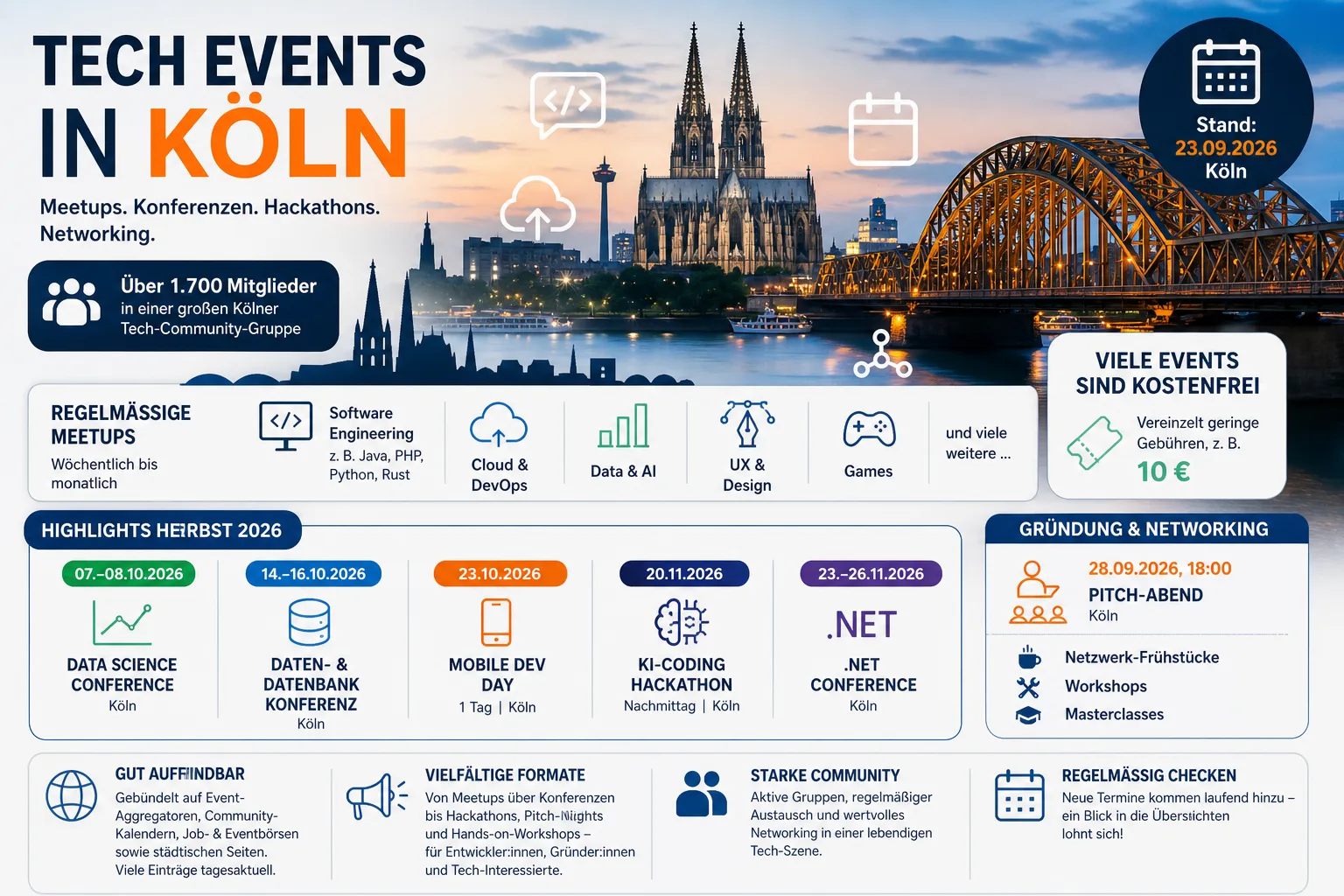
If you are now looking for tech events in Cologne, you will mainly find formats that are strongly focused on community, practical experience, and exchange. Typical are evenings with talks and networking, full-day workshops, and hackathons where teams present a result in a short time.
For your planning, it's important: Dates are often published on a rolling basis and quickly booked out if demand is high. That's why it's worth setting up a system where you see events early (calendar/newsletter) and can decide quickly.
2) Meetups: Formats, Process, and How to Prepare
In the coming months, many meetups on development, cloud, data/AI, UX, security, and product are expected to take place in Cologne. Even if the topics change depending on the group, the process often follows a similar pattern.
Typical Components of a Meetup Evening
- Keynote talks (approx. 20–40 minutes) with a clear question, e.g., architectural decisions, tooling, lessons learned.
- Lightning talks (5–10 minutes) for quick learnings or new libraries/features.
- Live demos (if the format fits), such as a mini app, a pipeline setup, or a small ML experiment.
- Q&A, often the most valuable part if you bring concrete problems from your daily work.
- Networking afterwards (often informal, sometimes with moderated introduction formats).
How to Get More Out of the Next Meetup
- Pre-check: Read the event description and note 1–2 questions you want to bring (e.g., “How do you solve observability?”).
- Prepare an introduction sentence: Who are you, what are you working on, what are you looking for (exchange, job, co-founder, feedback)?
- After the talk: Approach speakers directly (“I have the same problem—what first step would you recommend?”).
- Follow-up: Connect promptly (LinkedIn/GitHub) and send a short context sentence about what you talked about.
Many meetups are free or low-cost. But don't rely on that: Always check during registration if there are tickets, waiting lists, or no-show rules.
3) Hackathons: From Idea to Prototype in 24–48 Hours
Hackathons that will be announced in Cologne in the future are often thematically focused (e.g., AI, sustainability, smart city, health tech, mobility, developer tooling) and rely on interdisciplinary teams. Even if you have never participated before: Many events are designed so that you can join as an individual and find a team on site.
What a Hackathon Program Typically Includes
- Kick-off with topic introduction, rules, evaluation criteria, and pitch rounds for team formation.
- Build phase (24–48 hours or over a weekend), often with mentoring slots.
- Check-ins (optional): short status, blockers, request for help.
- Final pitches/demos with jury or audience voting.
Practical Strategy for Your Next Hackathon
- Choose a realistic idea: A “small, clear core benefit” beats a concept that's too big.
- Define a minimal goal: What must work in the demo for it to count as a success?
- Plan roles: Tech, design, pitch/story—even in small teams, clear responsibilities help.
- Document continuously: README, screenshots, short architecture notes—helps with the pitch and later for your portfolio.
- Build on existing tools: Templates, starter kits, managed services save time (check license and usage conditions).
If you want to use the hackathon as a career booster, make sure you have a presentable result at the end: a repository, a short demo URL (if allowed), and a clear problem-→solution story.
4) Conferences, Pitch Nights, and Startup Formats: What to Watch Out For
In addition to meetups and hackathons, you will also find conferences, theme days, workshops, and pitch formats in Cologne in the future. These mainly differ in goal and depth:
- Conferences: multiple tracks, often highly curated; ideal if you want many perspectives on a topic in a short time.
- Workshops/masterclasses: hands-on, limited seats; worthwhile if you want a skill upgrade with direct output.
- Pitch nights/demo days: relevant for founding teams, product people, and anyone seeking market feedback or contacts in the startup scene.
- Networking formats: Focus on exchange, partnerships, sometimes also recruiting.
Three questions help you decide whether to participate: (1) Do you want to learn or present? (2) Are you looking for contacts (and which ones exactly)? (3) Does the format fit your current time budget (evening, full day, weekend)?
5) How to Find the Next Dates (Including Checklist)
To reliably find upcoming tech events in Cologne from now on, it's best to combine several sources. Each source has strengths—together they reduce the risk of missing dates.
Proven Ways to Search for Events
- Meetup platforms: good for local groups, regular evenings, and RSVP/waitlists.
- Event platforms (ticketing): good for larger formats, workshops, and thematic series.
- Hackathon directories: good if you are specifically looking for hackathons and competitions.
- Websites of local hubs/coworking spaces: often the first stop for their own series.
- City/regional startup and business development sites: relevant for startup workshops, networking, and pitch formats.
Checklist: Is an Event Reputable and Suitable?
- Transparency: Are organizers, agenda, and participation conditions clearly named?
- Content: Are topic and target group clearly described (beginner vs. advanced)?
- Costs: Are ticket price, cancellation/no-show rules, and any participation requirements clear?
- Location & time: Are travel/admission times realistic (especially for evening events)?
- Data protection: Is registration data processed transparently (e.g., via platform policy)?
6) Planning for Fall/Winter 2026: Topics Likely to Appear Frequently
For the event season from fall 2026 and into winter, it is expected that many organizers will announce programs around these focal points:
- AI in practice: LLM workflows, RAG/agents, evaluation, governance, cost control.
- Cloud & platform engineering: Kubernetes patterns, observability, security-by-design, FinOps.
- Data engineering: Data quality, pipelines, real-time streaming, data products.
- Security: AppSec, supply chain security, threat modeling, secure CI/CD.
- UX & product: Research methods, design systems, experimentation, accessibility.
- Founding & go-to-market: Pitching, validation, pricing tests, funding logic.
If you want to focus, choose two topics for the next 6–8 weeks (e.g., “Data/AI” and “DevOps”) and attend one meetup plus a more intensive format (workshop or hackathon) per topic. This creates recurring contacts—and that's exactly what makes future events increasingly valuable for you.
Sources
- Meetup — Platform to search for upcoming local tech meetups (accessed 2026-09-23)
- Eventbrite — Ticketing and event platform for upcoming workshops, conferences, and meetups (accessed 2026-09-23)
- Devpost Hackathons — Directory of upcoming hackathons and online/on-site events (accessed 2026-09-23)
- Hackathons.com — Overview of current and future hackathon formats (accessed 2026-09-23)
- Startup Cologne — Regional hub for startup and event information in the Cologne area (accessed 2026-09-23)