Discover Student & University Student Events in Cologne
Student & University Student Events in Cologne (Preview 2026/2027): How to Plan Your Next Step Towards University
Do you want to get to know Cologne not just as a city, but as a potential place to study—before you apply? In the coming months and semesters, Cologne's universities, counseling centers, and networks typically offer many orientation and hands-on formats that support you between school and campus: from trial lectures and campus tours to workshops, mentoring, and career formats.
This overview helps you to find upcoming events, make meaningful choices, and prepare in a way that you really get something out of it—no matter if you are still in middle school, about to graduate, or already studying.
Orientation Days, Trial Courses & Campus Tours
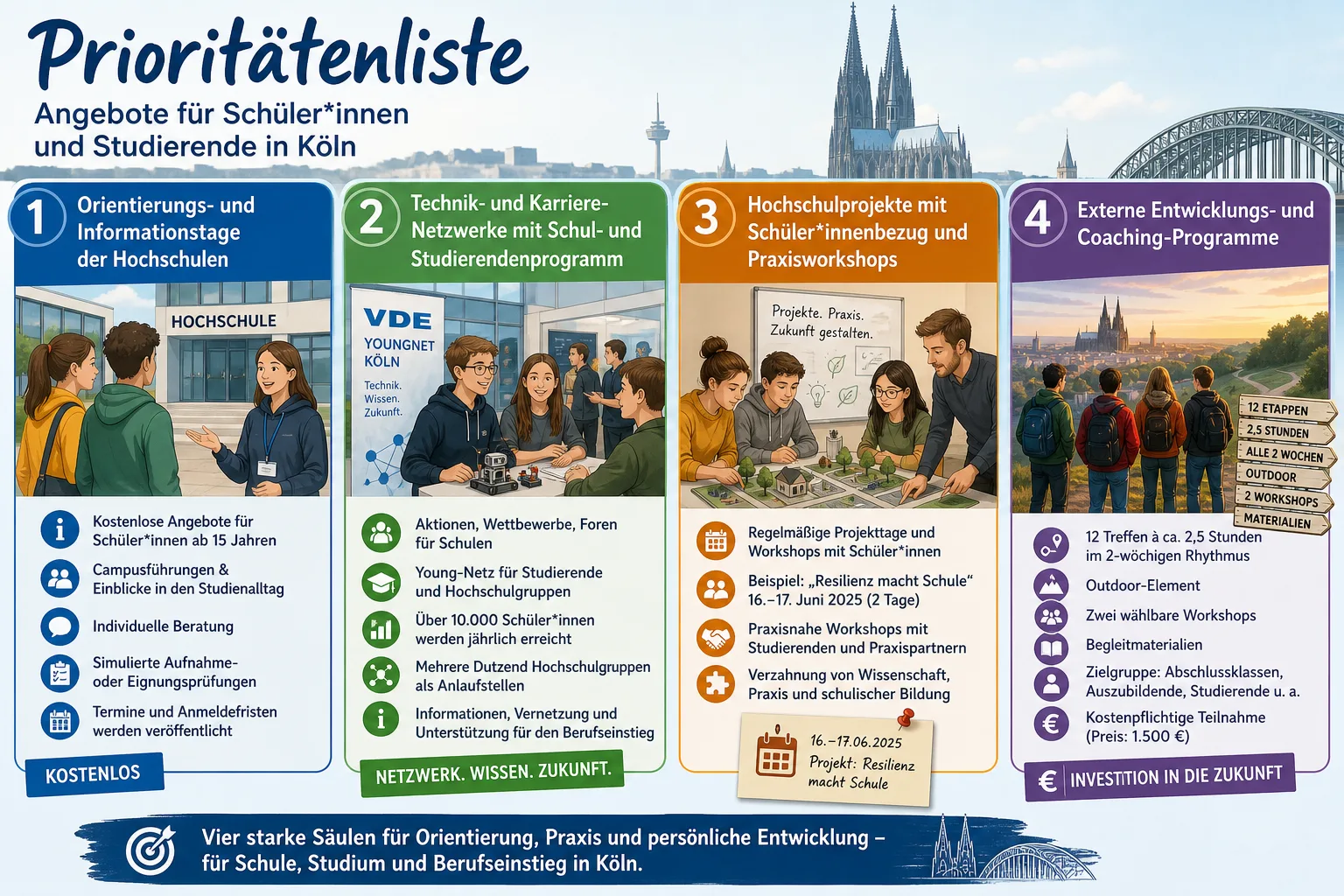
For 2026/2027, you can typically expect orientation and information days in Cologne that give you a realistic impression of everyday university life. Formats that not only inform but also let you actively try things out are especially helpful.
What you can actually do at these future events
- Attend trial lectures and seminars (get to know the process, pace, working methods)
- Join campus tours (library, study spaces, labs, cafeterias, service facilities)
- Use academic advising (content, requirements, typical study plans)
- Clarify application questions (deadlines, documents, NC/procedures, aptitude tests)
- Discuss financing & housing (BAföG, part-time jobs, dorms, budget planning)
How to recognize a good orientation offer
- There are concrete program points (not just general promotional info).
- You have contact with students (peer perspective instead of just brochures).
- Next steps are explained (registration, counseling, further dates).
- The information is current and traceable (e.g., with links to official sites).
Networks & Career Formats: Mentoring, Excursions, Recruiting
In addition to classic university formats, you will probably also find networking events in Cologne in 2026/2027 that connect school, university, and the working world. The focus is on orientation, entry, and contacts—without you having to be "fully decided" yet.
Typical future event types
- Mentoring and matching formats (students or professionals as contacts)
- Career and internship formats (company presentations, Q&A, application checks)
- Excursions and company visits (get to know processes, teams, activities live)
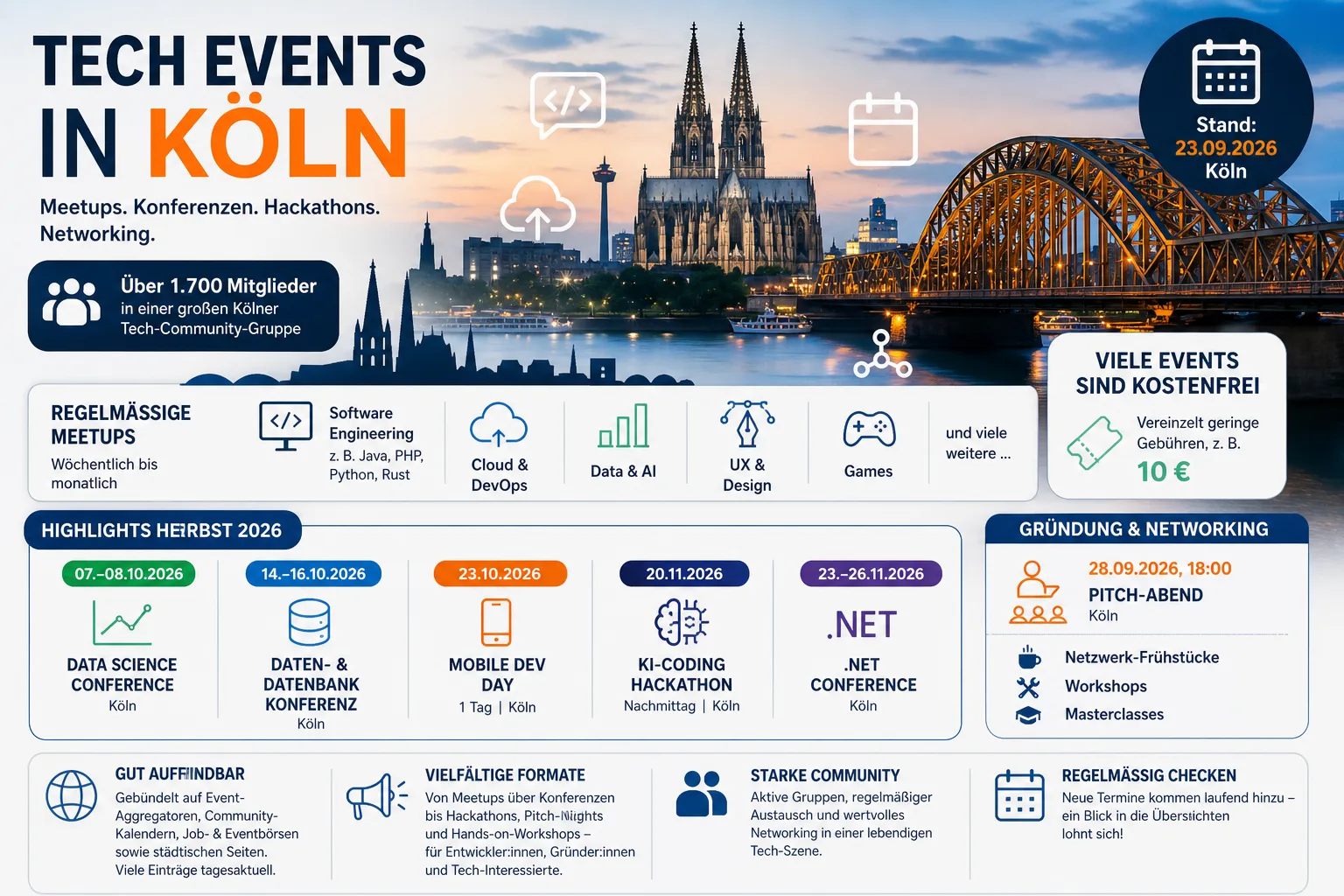
- Subject community meetings (e.g., Data/Tech/Design/Social—depending on the scene and provider)
How to make good use of networking events
- Set yourself a goal: 3 contacts, 1 concrete next step, 1 new insight.
- Ask about: internships, student jobs, entry paths, typical misconceptions.
- Ask for reliable info channels (newsletters, event calendars, career service pages).
Practical & Project Events: Workshops, Labs, Transfer
If you don't just want to listen but actively participate, project-oriented events in Cologne are especially valuable. For the coming semesters, formats are likely in which school groups, students, and practice partners work together on a topic.
Examples of future practical formats (without specifying individual providers)
- Workshop days on learning, presenting, academic work, or media literacy
- Lab and experiment days (try out STEM methods, collect and analyze data)
- Project sprints (understand a problem, develop an idea, present prototype/result)
- Transfer formats (research explained in an understandable way and related to everyday life/school/organizations)
Such events are especially suitable if you want to find out whether you like the working methods of a subject: reading and discussing, calculating and modeling, designing and iterating, advising and moderating—depending on the field of study.
Coaching Programs & Skills Training (multi-week)
In addition to individual appointments, you will probably also find multi-part programs in Cologne in 2026/2027 that run over several weeks. These offers are often more intensive than a single info evening—and are suitable if you want to work specifically on skills.
What such programs are often about
- Clarifying goals (Which field of study/training suits me?)
- Decision strategies (compare options, set priorities)
- Self-organization (learning, time management, planning exam phases)
- Communication (conversations, teamwork, conflicts)
- Presentation (application, interview, portfolio—depending on the field)
When choosing, pay attention to transparency: Who leads the program, which method is used, which results are realistic, and what costs may arise? Serious providers clearly state content, qualifications of the leadership, and framework conditions.
How to choose the right events (Checklist)
So that you don't just attend "anything" in Cologne in 2026/2027, but find the right formats for you, a short selection routine helps:
- Decide your focus: Find a field of study, compare universities, clarify application questions, test practice, or make contacts.
- Check the target group: For pupils (which grades?), prospective students, first-year students, advanced students.
- Assess the benefit: Are there concrete insights (trial/workshop) instead of pure self-promotion?
- Check requirements: Registration, ID/school certificate, participation limit, language.
- Plan realistically: Travel, duration, breaks, follow-up (notes, links, contacts).
Preparation: Questions, Documents, Behavior on Site
Good questions for future orientation days & counseling
- Which modules are in the first two semesters—and how are they examined?
- What does a typical week look like (attendance, self-study, group work)?
- Which prior knowledge is realistically needed—and how can I build it up before starting my studies?
- Which application deadlines apply (and what are the most common mistakes in documents)?
- What alternatives are there (related courses, training, dual options)?
What you can bring
- Notes app or notebook (for links, names, next steps)
- List of questions (3–5 points are enough)
- Optional: short CV (if it is explicitly a career/recruiting format)
After the event: How to make it really helpful
- Write down 3 insights within 24 hours.
- Derive 1 decision or 1 test from it (e.g., another trial date, counseling, internship).
- Save official links to deadlines/requirements as bookmarks.