The History of Cologne in 10 Stops
The History of Cologne – Excitingly Told in 10 Stops (as a Time Travel Route for Your Next City Moments)
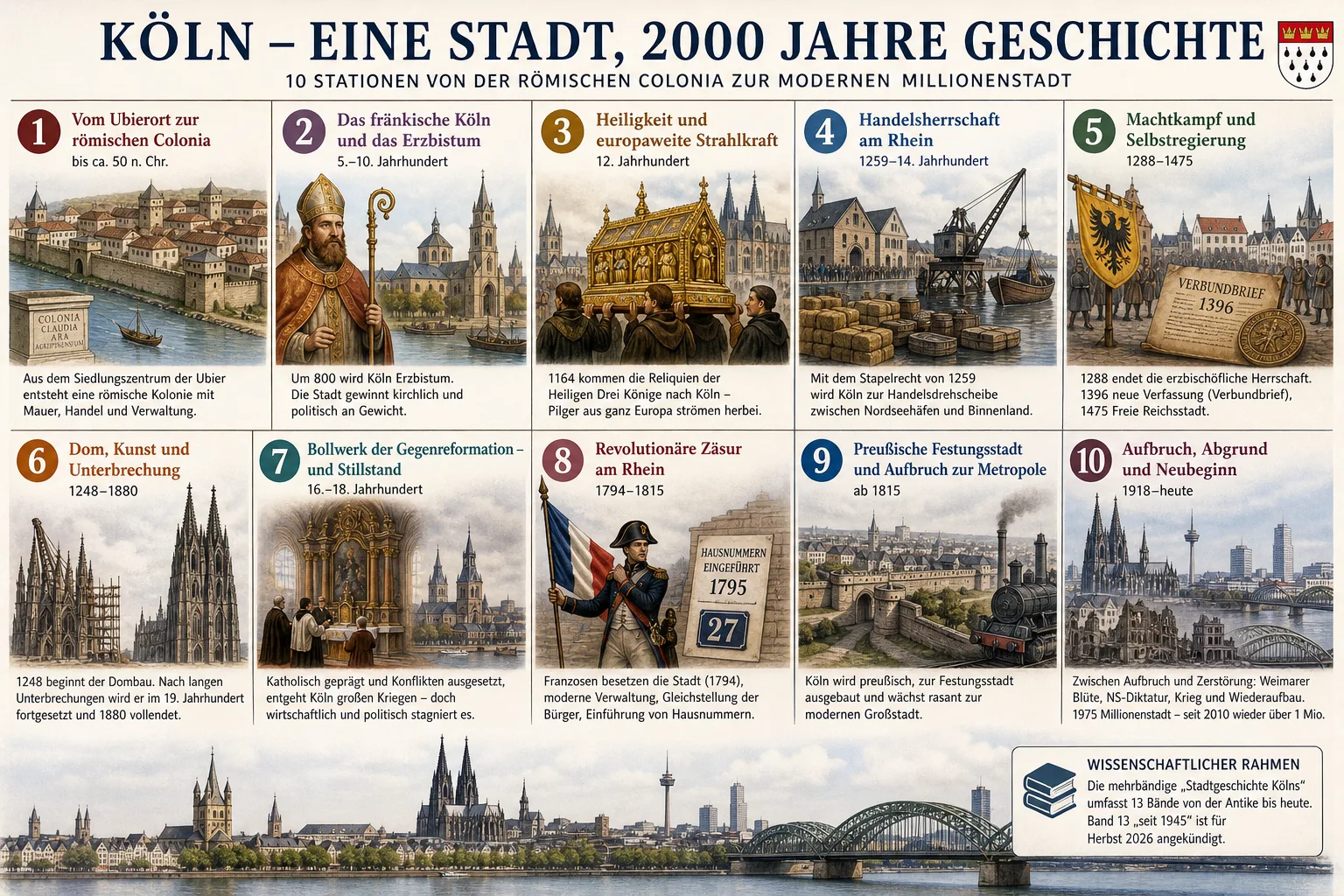
Would you like to experience Cologne in the coming days or weeks like an open history book—without dry memorization of dates, but with clear connections? This route guides you in ten stops through central narrative threads that you can discover on site (or as a self-guided tour): from the early beginnings of the city on the Rhine through religious influences and trade to administration, urban development, and culture of remembrance.
Stop 2: Cologne as an Ecclesiastical Hub
At the next stop, you will focus on Cologne's role as a church-influenced center of power and organization. On your tour, you will trace how religious institutions can structure city life, education, administration, and representation.
- What you will take away: Why church networks have supraregional effects—and how this becomes visible in the cityscape.
- Guiding question: What functions can a city take on when it is perceived as a religious center?
Stop 3: Cathedral, Pilgrimage, and City Narratives
At this stop, you will read the cathedral as a place of ritual, visitor culture, and city narrative: What stories are retold here for future generations—and how do paths, festivals, and identity emerge from them?
- Observation tip: Look for references to foundations, memorial plaques, brotherhoods, or pilgrimage traditions in tours and information material.
- Guiding question: How does "attraction" (spiritual or cultural) change a city's economy?
Stop 4: Trade on the Rhine – Rules that Make Markets
At the fourth stop, the focus is on trade, rules, and infrastructure. You will learn how legal privileges, customs, storage, and transshipment points can determine the economic rhythm of a city—and why a river is more than just a backdrop.
- What you can specifically look for: former market or storage areas, trade routes, harbor references in street names.
- Guiding question: What power arises when flows of goods are deliberately "bundled"?
Stop 5: Citizenship, Council Culture, and Self-Organization
At stop five, you will explore how a city society can be told in the future when self-organization, representation of interests, and conflicts play a role. You will understand why urban order does not only come from "above," but also arises through associations, offices, and negotiation.
- What you will pay attention to: Town halls, guild and association references, symbols of civic representation.
- Guiding question: How does economic strength turn into political influence?
Stop 6: The Cathedral as a Long-Term Project (Construction, Art, Symbol)
This stop deepens your upcoming cathedral perspective: You will view the construction as a long-term project—with changing priorities, financing ideas, architectural styles, and restoration logic. Thus, architecture becomes a mirror of what a city considers important at different times.
- Practical focus: Choose a tour in advance that explicitly addresses construction history, art, and preservation.
- Guiding question: How does a building become a symbol that continues to have an impact across generations?
Stop 7: Confession, Education, and Social Order
At stop seven, you will deal with the topic of confession and social order: How can religious lines of conflict, educational institutions, and social norms shape urban coexistence—and what traces of this can still be "read" on a future city walk?
- What you can compare on site: Locations of churches, schools, former monasteries, or educational sites.
- Guiding question: What happens to a city when it slows down change rather than shapes it?
Stop 8: Modern Administration in Everyday Life – Orientation & Addresses
This stop makes history tangible in everyday life: You will see how administrative logic will be noticeable in your own city experience in the future—through clear addresses, systematic orientation, and the idea that the city should be "countable and findable."
- Mini-experiment for your route: At an intersection, note the address logic (number sequence, street system) and check how quickly you can find your way without a map.
- Guiding question: What small systems of order make a big city manageable in the first place?
Stop 9: Urban Development – From Fortification Ideas to Growth
At stop nine, it's about spaces, boundaries, and growth. On your upcoming tour, you will understand how military, transport, or planning guiding ideas can shape city boundaries—and how parks, axes, and neighborhoods later emerge from them.
- What you can observe: Transitions between dense and open urban spaces, ring or belt structures, large corridors for traffic.
- Guiding question: How does a city change when limitation turns into expansion?
Stop 10: Remembrance, Upheavals, and Reassessment in Urban Space
The last stop is deliberately reflective: You will experience Cologne as a landscape of remembrance—with memorial sites, museum narratives, stumbling blocks of city history, and questions about responsibility, perspective, and representation.
- Recommendation for your tour: Plan time for a quiet section (e.g., museum, documentation site, or memorial) and note three impressions you would like to look up later.
- Guiding question: How does "the past" become a responsible public memory?
Practical Planning for Your Time Travel
How to Turn the Route into a Future Experience
- Choose your format: Self-guided with notes, audio guide, or a themed tour (e.g., "Trade," "Churches," "Urban Development," "Culture of Remembrance").
- Plan in sections: Divide the ten stops over two days if you want to visit museums or interiors.
- Accessibility: Check the current information for each location before your visit (access, elevators, rest areas).
- Families & school classes: Work with guiding questions (one per stop) to keep the tour interactive.
What This Route Consciously Does Not Do
This route is a planning and narrative structure for your upcoming explorations. Specific opening hours, ticket prices, and up-to-date access may change and should be checked on the official websites of the respective institutions before your visit.
Sources & Further Information
- City of Cologne (official portal) — Culture, city history, institutions (accessed 2026-08-26)
- Cologne Cathedral (official site) — Information on the cathedral, mediation, and visits (accessed 2026-08-26)
- Museums Cologne (official museum portal) — Program and mediation offers (accessed 2026-08-26)
- LVR (Rhineland Regional Council) — Cultural and knowledge offers for the Rhineland (accessed 2026-08-26)
- Federal Agency for Civic Education (bpb) — Background texts on German history and culture of remembrance (accessed 2026-08-26)
- Historical Archive of the City of Cologne — Access to sources, holdings, and city history (accessed 2026-08-26)