Citizens' Assembly in Cologne: Experience City Politics Live
Citizens' Assembly in Cologne: Experience City Politics Live and Have Your Say in the Future
How a citizens' assembly in Cologne typically works, which topics will be discussed there in the future, and how you can prepare to effectively present your concerns.
Overview: What to Expect at a Citizens' Assembly in Cologne
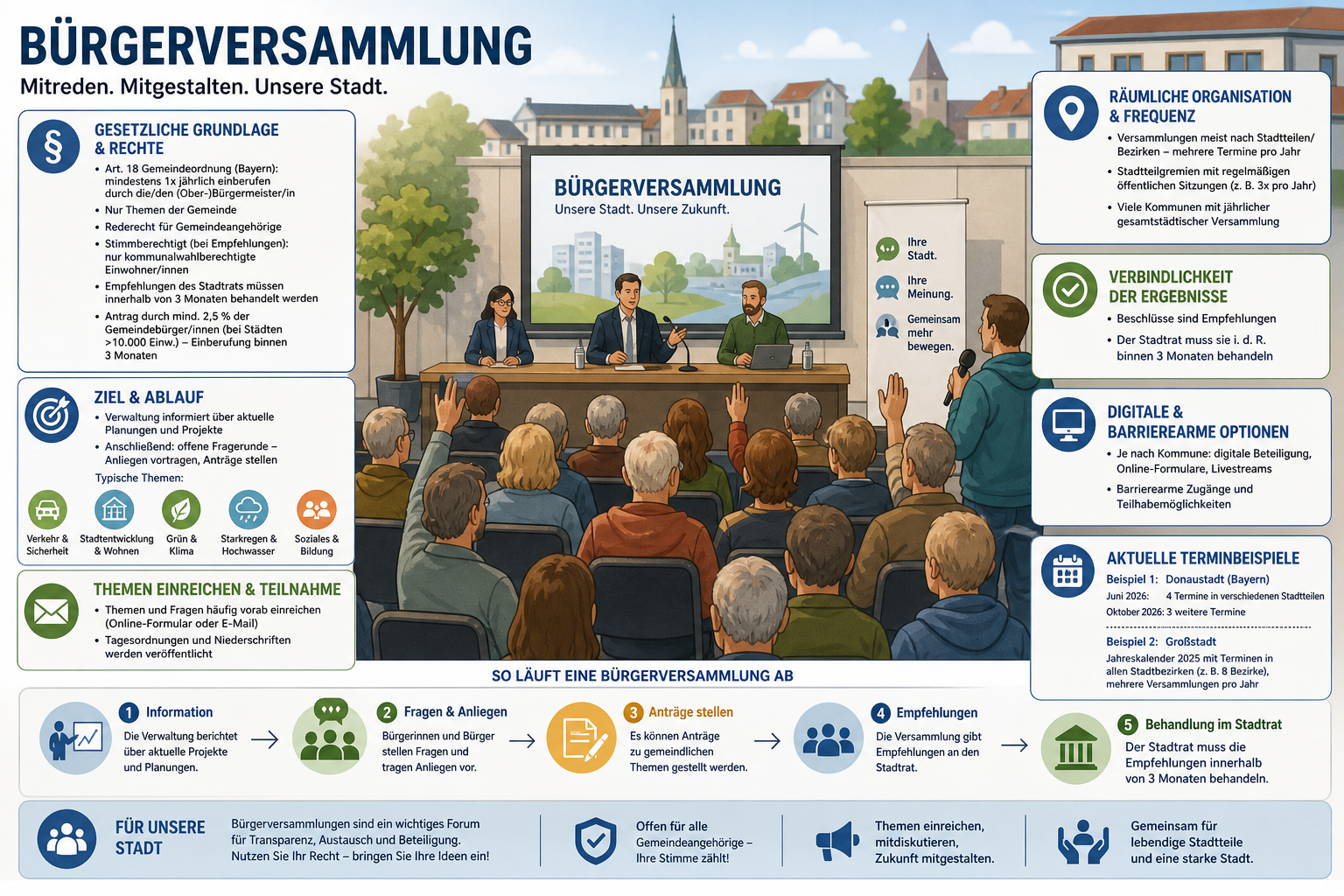
If you want to attend a citizens' assembly in Cologne in the next few weeks or months, you will experience a format that brings together administration, politics, and residents in a public setting. The focus is on local topics that can directly affect everyday life in the district or neighborhood—for example, traffic safety, school and daycare planning, climate and heat protection, urban greenery, housing, or heavy rain prevention.
Important for your expectations: A citizens' assembly is usually not a decision-making body like the council or a district representation. Its main purpose is to make information transparent, clarify questions, and bundle concerns so that politics and administration can subsequently process them in a structured way.
What is a Citizens' Assembly—and What Is It Not?
What it is
- Public participation format for local matters.
- Dialogue space where questions, criticism, and suggestions become visible and can flow into the further work of administration and committees.
- Information and clarification forum that aims to make the background of ongoing or planned projects understandable.
What it is not
- Not a council meeting: Usually, no legally binding council resolutions are made.
- Not a party format: It is not about party-political campaigns, but about local factual issues.
- Not a substitute for formal procedures: For major projects (e.g., land-use planning), legal participation steps and deadlines remain decisive.
The specific designation and structure used by the city (e.g., citizen information, citizen dialogue, residents' assembly) may vary depending on the occasion. For classification, it is worth looking at the official participation information of the City of Cologne and the legal foundations in North Rhine-Westphalia.
Rights, Procedures, and Binding Effect: What Your Voice Can Achieve in the Future
If you speak up in the future, your contribution can have an impact on three levels:
- Transparency: You (and others with you) receive comprehensible information—for example, about responsibilities, schedules, considerations, and limitations.
- Prioritization: Recurring concerns (e.g., school route safety at a specific intersection) can be bundled and passed on as a work order to the responsible authorities.
- Political and administrative follow-up process: Documentation and public follow-up increase the pressure to review, justify, and—where possible—implement concerns.
How binding the follow-up steps are depends on the respective format, the moderation/leadership, the specific question, and the legal responsibilities. Reliable guidance is provided by:
- the municipal legal rules in NRW (e.g., participation and responsibility framework),
- the official information from the City of Cologne on participation, dates, and contact channels,
- the documentation (e.g., result overviews, minutes, or summaries), if published.
Practical tip for future events: Formulate your concern so that it is understood as a verifiable request—with location, time frame, affected groups, and a concrete request (e.g., "examination of a crossing aid," "information on the schedule," "justification of the decision," "alternative measure").
Typical Procedure: How You Can Prepare for an Upcoming Citizens' Assembly
1) Arrival and Orientation
At the beginning, the occasion, goals, discussion rules, and procedure will likely be explained. It is also often explained how questions are collected (microphone, speakers' lists, card submission, or digital channels) and how results are recorded.
2) Information on Projects and Responsibilities
In the information section, you can expect that ongoing or planned projects will be presented—depending on the focus, for example, with plans, maps, or key figures. For you, this is the moment when you can check:
- What decision is coming up next (and when)?
- Which office or company is responsible?
- Which formal participation steps will follow (e.g., public display, hearings, online participation)?
3) Questions, Contributions, and Concrete Concerns
In the discussion, you will probably be able to ask questions or bring up concerns. To ensure your contribution is understandable and well documented, the following has proven effective for future statements:
- One sentence of context (Where exactly? What situation?).
- One or two observations (What happens regularly?).
- A clear request (What should be checked/explained/changed?).
- If possible: a concrete reference to safety, accessibility, school route, noise, climate resilience, or quality of stay.
Dates, Location, and Access: How to Find Upcoming Events in Cologne
For future citizens' assemblies, the most reliable sources of information are the official channels of the City of Cologne (e.g., municipal websites, announcements, and event overviews) as well as the pages of the district representations or responsible departments. Pay particular attention to:
- Date, time, venue (and whether registration is required),
- Key topics or affected streets/neighborhoods,
- Accessibility (step-free access, induction loop, sign language, plain language),
- Participation options (on-site, livestream, digital question channels—if offered).
If you want to participate regularly, it may be useful to note the main contact points for citizen participation and to use invitation/newsletter offers if available.
Bringing in Topics and Having an Effective Say: Checklist for Your Next Event
Before the Event
- Clarify the question: Is it about information (schedule/justification) or a concrete change (measure/examination)?
- Gather facts: Location (street/section), time frame, affected people (children, elderly, cyclists), frequency.
- Review documents: If plans or templates are published, read the summary and note any questions.
- Prepare your statement: 30–60 seconds core concern + a clear question.
During the Event
- Stay on point: One question per contribution is often most effective.
- Argue respectfully: Focus on the issue, safety, impacts, and alternatives.
- Ask about responsibility: "Who is responsible and by when will there be feedback?"
After the Event
- Check documentation: Is there a summary of results or minutes?
- Follow-up: If a contact person is named, ask about the next step and the expected time frame.
- Use further participation: For formal planning procedures, deadlines are crucial—plan time for statements early.
Why Citizens' Assemblies Can Help Shape Cologne's Future
In the coming years, decisions will be made in Cologne that directly affect many people—for example, regarding mobility, climate-resilient urban development, social infrastructure, and the use of scarce space. Citizens' assemblies can help make practical everyday experiences visible at an early stage, identify goal conflicts, and develop better solutions.
If you participate, a decision "as desired" does not automatically result. However, it is realistic that well-founded, concretely formulated contributions improve the quality of considerations—because they bring local experience, safety aspects, and usage realities into further planning.